Small Bottle Filling: Choosing a Machine for Small Runs

Small bottle filling is best done with a machine matched to your product’s thickness, your bottle size and your batch size, not to the biggest line you can afford. For most UK start-ups and small manufacturers the sensible path is a semi-automatic filler first, then an automatic one when hand-fed bottles become the bottleneck. This guide explains how to make that choice, what the law expects of you, and what to check before you buy.
TL;DR
- Start with the product: water-thin liquids, creams and gels need different filling principles, so viscosity decides the machine before price does.
- Semi-automatic fillers suit short runs and frequent changeovers; automatic fillers pay back when one operator is filling the same bottle all day.
- In the UK, packs between 5ml and 25 litres fall under the Average System for quantity control, so filling accuracy is a legal matter, not only a quality one.
- A UKCA or CE mark does not replace your own duty under PUWER to check the machine is safe and suitable on your site.
- Plan the whole bottle path: filling, capping and labelling, even if you buy them one at a time.
Table of Contents
- What counts as small bottle filling
- Start with your product, not the machine
- Semi-automatic or automatic: what changes
- How to judge filling accuracy
- The UK rules that apply to your filled bottles
- Buying the machine: your legal duties
- Fill, cap, label: plan the whole bottle path
- Our view: buy for the next two years
- Talk to us about your bottles
- FAQ
- Sources
What counts as small bottle filling
There is no formal definition, but in practice people searching for this mean one of three situations:
- Small containers: dropper bottles, vials, sample jars and 10ml to 100ml cosmetic or nutraceutical bottles, where a few drops of error is a large percentage of the dose.
- Small batches: a few hundred to a few thousand bottles per run, often with several products and sizes on rotation.
- Small businesses: a team of two to ten people, usually moving from filling by hand or by syringe into proper equipment for the first time.
The first situation is about precision, the second about changeover speed, the third about budget and floor space. A good machine choice answers all three at once, and the order of priority differs for each business.
If you fill by hand, the signs it is time to change are easy to spot: inconsistent fill levels between bottles, one person tied to the bench for hours, spillage that wastes expensive product, and a rework pile at the end of the day.
Start with your product, not the machine
Before comparing machines, write down five facts about what you are filling. A reputable manufacturer will ask for the same five.
- Viscosity: thin liquids such as tinctures, e-liquids, juices and water-based serums behave very differently from oils, lotions, gels and sauces.
- Foaming and splashing: shampoos, soaps and some drinks foam if they fall freely into the bottle.
- Particulates or pieces: seeds, pulp or flakes need wider passages and suitable nozzles.
- Chemical compatibility: alcohol-based, acidic or essential-oil products can attack some seals and plastics.
- Hot or cold fill, and any need for cleaning between products: this affects materials and how quickly parts come apart for washing.
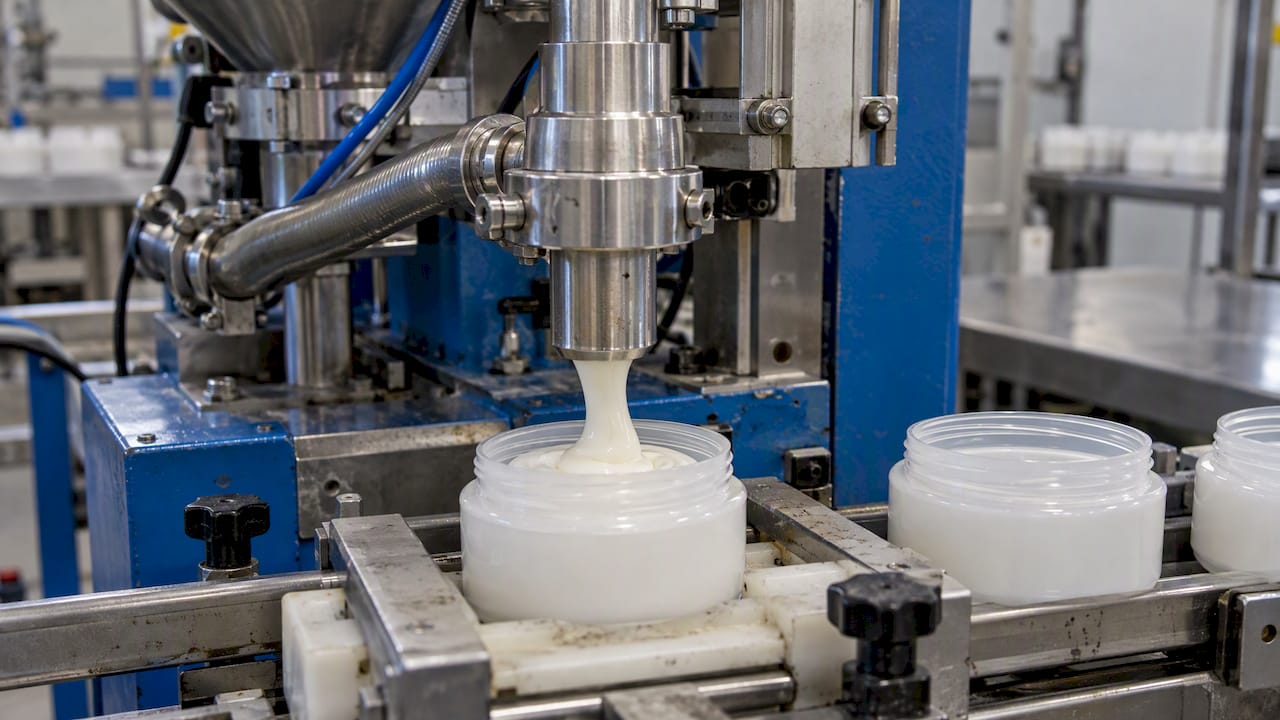
These answers narrow the field quickly. As a rule of thumb, free-flowing liquids can be filled with simple volumetric or level-based systems, while thick products usually need a positive-displacement principle that pushes a measured volume out of a chamber. Ask any supplier to run or discuss your actual product, not water, before you commit.
Our liquid filling machine range covers automatic and semi-automatic machines for a range of viscosities, and our guide on how to decide on the most suitable liquid filling machine walks through the same questions in more detail.
Semi-automatic or automatic: what changes
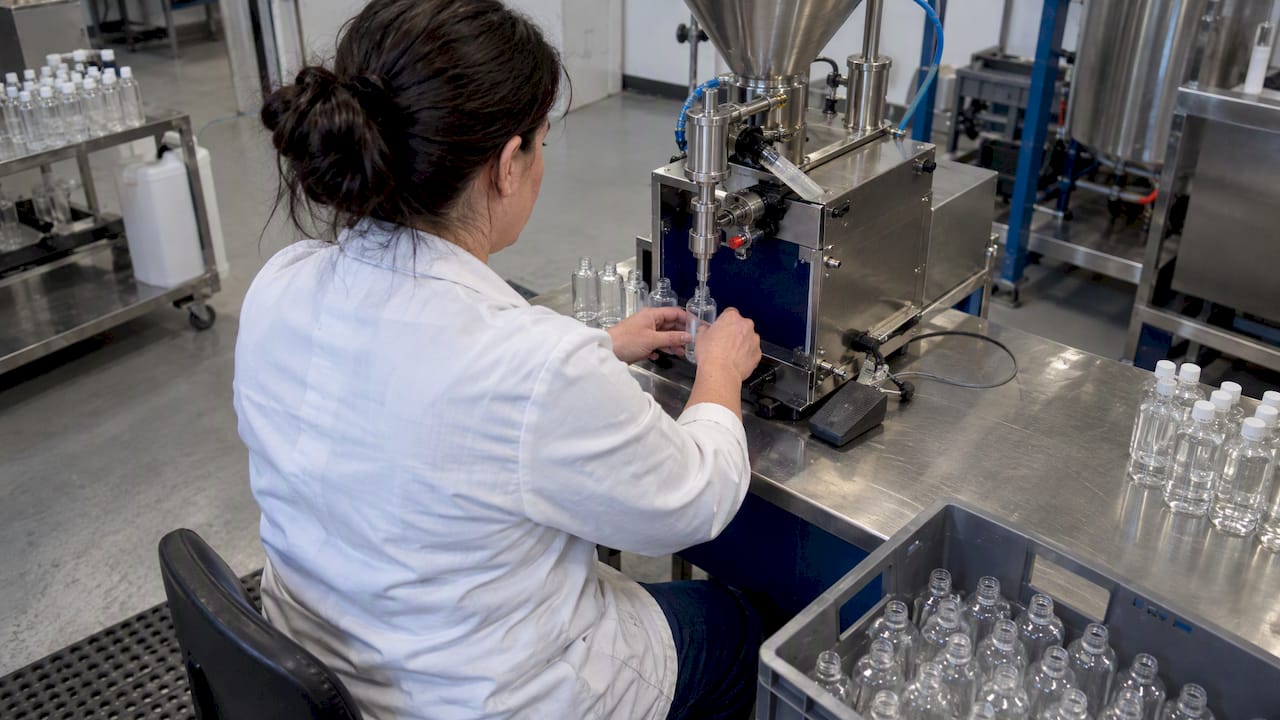
The real difference is who does what. On a semi-automatic filler an operator places the bottle, triggers the fill (often with a foot pedal) and moves the bottle on. On an automatic machine bottles travel on a conveyor, are detected, filled and released without a hand on them.
| Factor | Semi-automatic | Automatic |
|---|---|---|
| Typical use | Short runs, many products, start-ups | Repeat runs of the same bottle |
| Labour | One operator at the machine | Operator supervises and loads bottles |
| Changeover | Usually quick and simple | Needs setting of guides, nozzles and sensors |
| Floor space | Bench or small footprint | Needs conveyor and feed space |
| Upgrade path | Can sit in front of a capper and labeller | Can integrate into a full line |
Neither is better in general. A semi-automatic machine that is busy all day is a good investment; an automatic machine running two hours a week is not. Count the bottles you expect to fill over the next two years, not this month, and work out how many operator-hours that is.
Within our liquid range, the semi-automatic AF0010 liquid filler and the volumetric AF0020 filler are the natural places to begin for short runs, while the AF0080 automatic liquid filling machine and the AF0120 automatic bottle filling machine suit businesses that have outgrown hand-fed bottles. Prices are not published, so ask us for a quotation against your product and output.
How to judge filling accuracy
Accuracy claims mean little without context. Ask three questions.
Accuracy at which volume? A tolerance of a gram is trivial on a 1 litre bottle and enormous on a 10ml vial. Always ask for the repeatability at your smallest fill.
Accuracy with which product? Results on water do not transfer to a viscous gel that strings or a foaming liquid.
Accuracy over how long? Check performance after an hour of running, not only the first ten bottles. Temperature changes, product level in the hopper and wear all show up with time.
The practical test is simple: fill 20 to 30 bottles with your own product, weigh or measure each, and record the spread. Do this on the machine in front of you, or ask the supplier to do it and share the figures. Keep the records, because they double as evidence for the legal checks below.

The UK rules that apply to your filled bottles
Quantity control for packaged goods
If your bottles are sold sealed, hold the same nominal quantity as others of the same type, and contain between 5ml and 25 litres, the GOV.UK guidance on packaged goods applies. Most producers use the Average System, which rests on the Three Packers’ Rules:
- The average content of a batch must not be less than the nominal quantity stated.
- Only a small proportion of packs may fall short by more than the Tolerable Negative Error (TNE).
- No pack may be short by more than twice the TNE.
The TNE scales with pack size. For packs of 5 to 50g or ml it is 9% of the nominal quantity, and for 100 to 200g or ml it is 4.5%, according to the same GOV.UK page. On a 30ml bottle that gives you very little margin for a drifting filler, which is why repeatability matters so much at small volumes. The government’s guide to the Weights and Measures (Packaged Goods) Regulations 2006 explains how the system works in practice. Your local Trading Standards service is the body to ask if you are unsure how it applies to a particular product.
Food and drink
Pre-packed food must carry specified information on the pack or label, including the net quantity, as set out in GOV.UK’s food information guidance. Your filler and your labeller need to agree: a bottle filled to the right volume but labelled with the wrong quantity is still a problem.
Medicines and healthcare products
Medicine manufacturers must meet Good Manufacturing Practice, which GOV.UK describes as the minimum standard for production. In practice that means documenting the process and validating machine performance for the specific product and container. Choose equipment with parts that are easy to clean and document, and expect to keep installation and calibration records. If you are in this sector, speak to your Qualified Person and, where relevant, the MHRA before changing packaging or labelling.
Cosmetics
A cosmetics Responsible Person has to keep a Product Information File covering composition, manufacturing method, safety assessment and reports of undesirable effects, and keep it available for 10 years after the last batch is placed on the market, as local authority guidance for producers and importers explains. A change of filling method belongs in that file. Pack labels also carry symbols and warnings that need checking before print; this guide to packaging pictograms (in Slovenian) is a useful visual reference for what each symbol on a pack means.
Buying the machine: your legal duties
New machinery supplied in Great Britain must be safe, come with a Declaration of Conformity and English instructions, and carry the UKCA mark (or the CE mark where still accepted), as the HSE’s guide to buying new machinery sets out. That is the supplier’s side of the bargain.
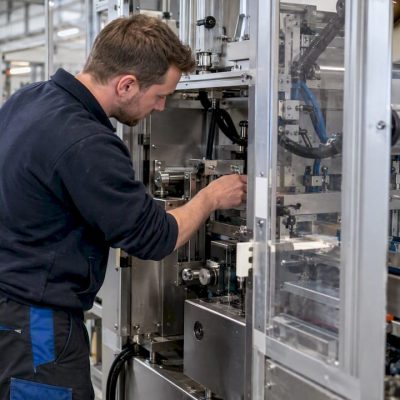
Yours starts when the machine arrives. Under PUWER you must make sure the equipment is suitable for its intended use, maintained in a safe condition and free from defects. The HSE’s introduction to machinery safety tells you to check that the machine is complete, with all safeguards fitted. A conformity mark is a declaration by the manufacturer, not a guarantee that the machine suits your room, your product or your operators.
A practical acceptance checklist:
- Guards and interlocks are fitted and work.
- Operators have been trained on start-up, cleaning and emergency stop.
- The machine has been tested with your product and bottle, not a demonstration sample.
- Cleaning and changeover steps are written down.
- Spares and a service contact are agreed before you need them.
Fill, cap, label: plan the whole bottle path
A filler rarely works alone. Once bottles are filled they need closing, often sealing, and labelling, and these steps can become the new bottleneck if ignored.
- Capping: screw caps, press-on caps and droppers each need a different head. Our capping machinery includes the AK 0040 automatic screw capping machine and a press capping machine.
- Sealing: tamper evidence matters for supplements, food and medicines. Our page on how to seal bottle caps explains the options, and we also build induction cap sealing equipment.
- Labelling: a semi-automatic bottle labeller is a sensible match for a semi-automatic filler.
- Feeding: an accumulation or rotary table collects finished bottles so one operator can run more than one step.
If you are a small business weighing which machines to buy first, our overview of packaging machines for small business sets out a sensible order.
Our view: buy for the next two years
We have built packaging machines for over two decades, with more than 1,650 installations worldwide, and the most common regret we hear is not that a customer bought too small but that they bought something that could not grow with them.
Our advice has three parts. First, test with your real product before you decide, because bottle shape, viscosity and foaming behaviour surprise people. Second, choose a machine whose parts you can change: a filler that handles 30ml today and 250ml next year saves a second purchase. Third, think about the people as much as the metal. Training and maintenance decide whether a machine still performs in year five, which is why we treat installation, training and ongoing support as part of the machine, not an extra.
This is also why we customise. A cosmetics brand filling serum, a nutraceutical company filling liquid supplements and a drinks producer filling small samples need different details even when the bottle looks the same, and the machine should be built around the job.
— Trevor
Talk to us about your bottles
If you are moving from hand filling or planning a first small line, tell us your product, bottle sizes and weekly volumes and we will recommend a filler, plus capping and labelling if needed. See the full liquid filling machines range or contact us through kbw-packaging.com for installation, training and ongoing support. Drinks producers can also look at our beverage filling solutions, and CBD oil producers at our monoblock machines for CBD oil filling.
FAQ
What is the best machine for filling small bottles?
It depends on your product and volume. For thin liquids in short runs, a semi-automatic volumetric filler is usually enough. For thick products, or when one person fills the same bottle all day, an automatic filler with a positive-displacement principle is the better choice.
Do I need to fill small bottles to an exact volume?
Not to the exact millilitre on every bottle, but you must meet the legal rules. Under the Average System the batch average must not be below the stated quantity, and individual packs must stay within the permitted shortfall. Check your own fill records regularly.
Can one machine fill different bottle sizes?
Usually yes, within a range. Changing size means adjusting guides, nozzles and the fill volume, and sometimes swapping parts. Tell the supplier your smallest and largest bottles at the start so the machine is specified for both.
Is a CE or UKCA mark enough to prove a filling machine is safe to use?
No. The mark is the manufacturer’s declaration, and under PUWER you still have to check the machine is suitable for your use, complete with guards and in safe condition, as the HSE explains.
Should I buy a filler first or label and cap first?
Usually the filler, because it is where inconsistency and waste show up most. Choose it with the next two machines in mind so that bottle height, speed and feeding all work together.
Sources
- GOV.UK: Weights and measures, packaged goods
- GOV.UK: Guide to the Weights and Measures (Packaged Goods) Regulations 2006
- GOV.UK: Food information, net quantity labelling
- GOV.UK: Medicines, good manufacturing practice and good distribution practice
- Southwark Council: Cosmetic products, guidance for producers and importers
- HSE: Buying new machinery
- HSE: Introduction to machinery safety