Cosmetic Filling Guide: Methods, Machines and Checks

Cosmetic filling is the step where a finished formula goes into its final bottle, jar, tube or pot at the right volume, without contamination, spillage or air pockets. Getting it right comes down to three decisions: how thick your product is, what container it goes into, and how many units you need per hour. This guide walks through each decision, explains which filling machine suits creams, lotions, gels and serums, and covers the hygiene and compliance points a UK producer should have in place before the first batch.
TL;DR
- Viscosity decides the filling method. Thin liquids suit gravity or volumetric fillers, while creams and thick gels usually need a piston filler.
- Container shape and neck size set the nozzle, the feed system and the line layout around the filler.
- Filling is only one station. Capping, induction sealing and labelling must keep pace with it, or the line stalls.
- UK cosmetics need a Responsible Person, a product information file and a safety report, and good manufacturing practice under ISO 22716 shapes how the filling area is run.
- Start semi-automatic if volumes are modest, but choose equipment that can be joined to an automatic line later.
Table of Contents
- What cosmetic filling involves
- Start with the product, not the machine
- Choosing a filling method by viscosity
- Containers and what they demand
- Filling is one station on a line
- A worked example: sizing a cream line
- Hygiene and good manufacturing practice
- UK compliance around the filling stage
- Common filling problems and how to avoid them
- Our perspective
- Talk to us about your cosmetics line
- Checklist before you buy
- FAQ
- Sources
What cosmetic filling involves
A cosmetic product leaves the mixing vessel as bulk. Filling turns that bulk into sellable units. The job sounds simple, yet it carries most of the day-to-day risk in a small production room: inaccurate doses give away product or breach declared contents, drips smear labels, trapped air leaves jars looking half empty, and unclean contact surfaces put the batch at microbiological risk.
The process usually runs in this order:
- Containers are presented, either loaded by hand or fed from an accumulation table.
- The product is dosed into each container.
- Closures are applied: a pump, screw cap, press-on cap or lid.
- An induction seal or other tamper evidence is added where the product calls for it.
- The label, batch code and any carton are applied.
The filler gets the attention, but every later step depends on how cleanly and consistently it works. A filler that leaves a ring of cream around the neck makes capping unreliable and labels look untidy, even if the volume is perfect.
Start with the product, not the machine
Before comparing machines, write down the facts about the formula. Machine suppliers will ask for them anyway, and they narrow the choice quickly.
- Viscosity. A toner or micellar water pours like water. A body lotion flows slowly. A rich night cream or balm barely moves.
- Particulates and texture. Exfoliating scrubs, glitter, seeds or whipped textures can jam narrow valves and need wider flow paths.
- Temperature. Some balms and butters are filled warm and set in the container, so heated hoppers may be needed.
- Foaming and air. Surfactant-heavy products foam if they splash, which calls for bottom-up or submerged filling.
- Ingredients that attack materials. Alcohol-heavy or acidic products need compatible seals and contact parts.
- Fill range. A 15 ml serum and a 500 ml shampoo may need different filling heads or even different machines.
Choosing a filling method by viscosity
| Product type | Typical examples | Common filling method | Watch for |
|---|---|---|---|
| Thin liquids | Toners, micellar waters, fragrance, hair oils | Gravity or volumetric filling | Dripping, foaming |
| Medium liquids | Lotions, shampoos, body washes, serums | Volumetric or piston filling | Air bubbles, stringing |
| Thick creams and gels | Face creams, hand creams, masks, gels | Piston filling | Air pockets, nozzle cut-off |
| Very thick or semi-solid | Balms, butters, pastes | Heated piston or hopper filling | Setting in the lines, temperature control |
This is how the process generally divides in the industry, and exact limits depend on the formula, so run your own product through any machine you are considering. A reputable manufacturer will let you test or will discuss your sample before you commit.
Volumetric filling for free-flowing products
A volumetric filler measures a set volume and delivers it each cycle, so accuracy depends on the dosing mechanism and not on the container. It suits lotions, serums, shampoos and similar products where the liquid moves readily. Our volumetric liquid filling machine AF0020 is an example of this approach, and the full liquid filling machine range covers different viscosities.
Piston filling for creams and gels
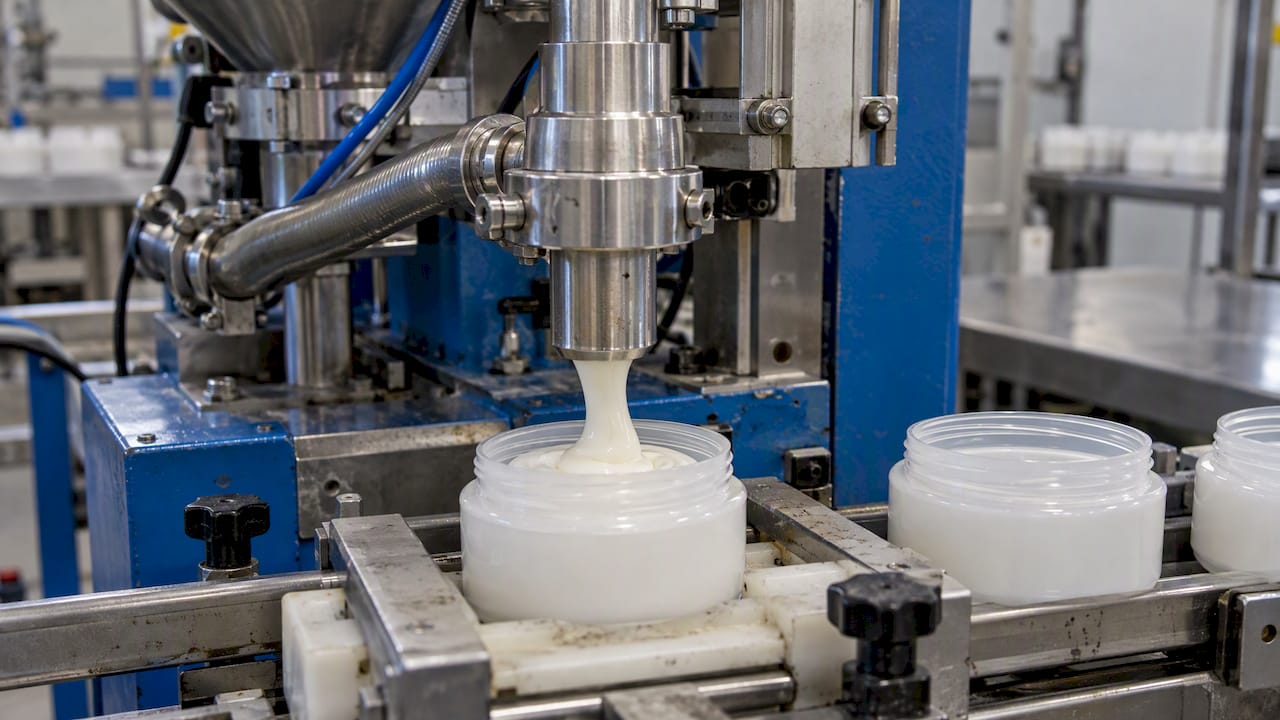
A piston filler draws product into a cylinder and pushes it out through a nozzle. Because the piston forces the product, it handles thick creams and gels that gravity could never move. The stroke can be adjusted for different fill sizes, and the same machine can often switch between pots, jars and wide-necked bottles by changing nozzles. If your search is for a cream filling machine, this is the family you will be comparing.
Semi-automatic or automatic?
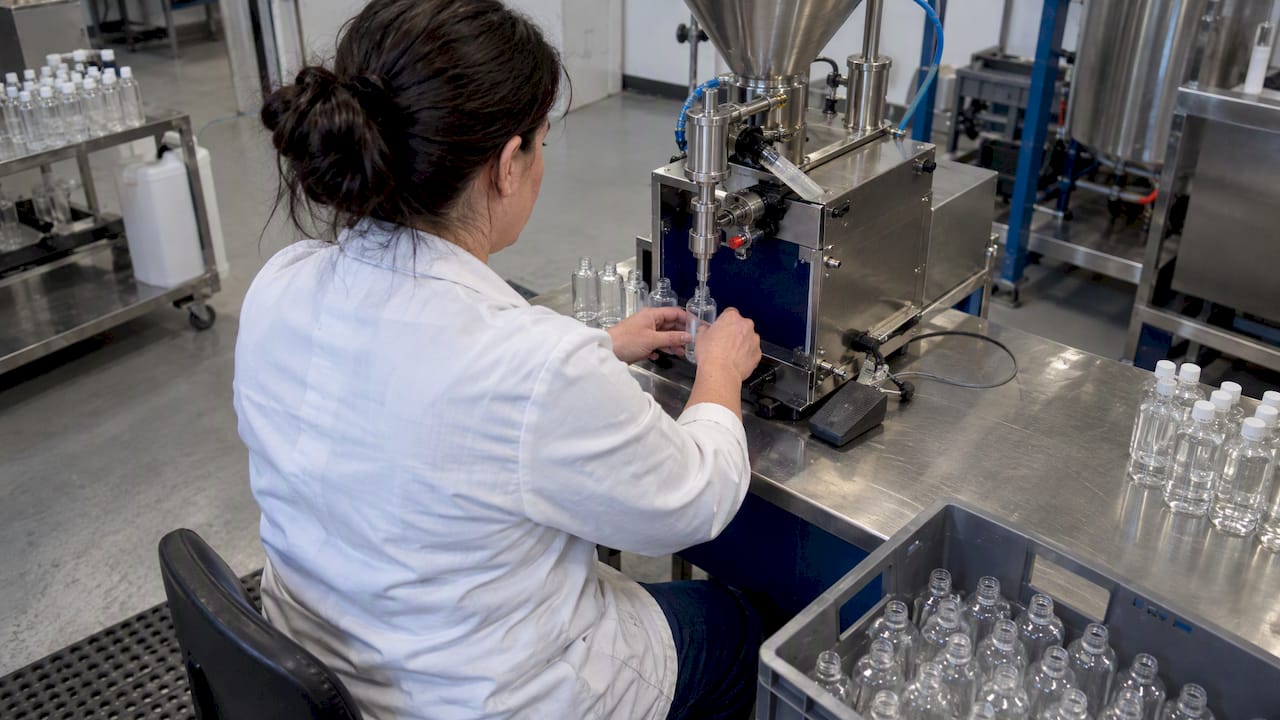
A semi-automatic filler needs an operator to place the container and trigger the cycle, often with a foot pedal. It is a sensible start for new brands, small-batch ranges and products with many sizes. An automatic filler indexes containers under the nozzles itself, which brings consistent output and frees the operator for other tasks.
Our semi-automatic liquid filler AF0010 suits the first route, while the automatic AF0040 and automatic AF0080 are for lines where throughput matters more. A practical rule: if you are filling by hand more than a few hours each week, calculate what that labour costs before deciding that automation is out of reach.
Containers and what they demand
The container changes the filling approach as much as the formula does.
Bottles with pumps or caps. The narrow neck limits how fast you can fill without splashing. Nozzles should be sized to enter the neck and, for foaming products, reach down toward the base.
Jars and pots. A wide opening makes cream filling straightforward, but the surface finish matters. A neat, level top is what shoppers see, so nozzle cut-off and height control are important.
Tubes. Tubes are usually filled from the open end and then sealed, which is a separate machine process from bottle filling. If tubes are a major part of your range, treat them as a distinct line rather than a variation.
Airless pumps and specialised packs. These are often filled in particular ways, sometimes from the base, and the supplier of the pack will advise. Ask before ordering.
Material also matters. Glass, PET, HDPE and PP behave differently with cap torque, label adhesion and heat. Keep a few sample containers from your actual supplier for machine trials, because dimensions that differ by a millimetre can cause a poor seal.

Filling is one station on a line
Many buyers specify the filler and then discover the rest of the line is the bottleneck. Plan the sequence together.
Feeding containers
An accumulation or rotary table holds empty or filled containers and releases them at a steady pace. It avoids the operator becoming a metronome and lets you load containers in bulk.
Capping
The closure must suit the container. Screw caps need controlled torque, press-on caps need consistent downward force, and pumps need to be seated without damage. Our capping machinery includes screw and press options such as the automatic screw capping machine AK 0040 and the press capping machine.
Sealing
If your product ships to retailers or online customers, tamper evidence and leak protection matter. Induction cap sealing equipment bonds a foil liner to the neck of the container. Our guide on how to seal bottle caps explains the options.
Labelling
A label that is straight, wrinkle-free and consistently positioned is what makes a small brand look established. Both automatic and semi-automatic options exist, from a portable bottle labeller for short runs to an automatic bottle labeller for higher volumes. You can see the whole range on our labelling machinery page.
A worked example: sizing a cream line
Suppose a skincare brand makes a 50 ml face cream in a jar and expects to sell 2,000 units a week. At that volume a semi-automatic piston filler, a semi-automatic labeller and a bench capper can handle a single shift with two or three people. Doubling or tripling that volume does not mean replacing everything. Often the filler stays, and the labeller or capper is upgraded first, because manual placement of labels and closures is where time disappears.
Now suppose the same brand adds a 200 ml lotion bottle and a 15 ml serum. The filler must now handle three fill ranges, so confirm that one machine covers the full range, or whether a second filling head is cleaner than constant changeovers. Cleaning between a pigmented product and a clear one also takes time, which is why many producers dedicate a filler to a product family.
The point is to buy for the next stage of growth, not only the current one, and to make sure each machine can later link to the next.

Hygiene and good manufacturing practice
Most cosmetic brands in the UK are expected to run to a recognised good manufacturing practice standard, and ISO 22716 is the reference. The standard calls for established hygiene programmes, suitable protective clothing for personnel entering production areas, and no eating, drinking or unhygienic practices in those areas. For a filling room, that translates into concrete habits:
- Clean and sanitise all product-contact parts between batches and record it.
- Choose stainless steel contact parts that dismantle quickly without tools.
- Keep filling away from raw material handling and open storage.
- Control who enters, what they wear and what they carry.
- Give each batch a code so any problem can be traced back.
Recording these checks is where many small producers struggle. Paper logs get lost, and operators skip fields. A digital approach helps, and an operator mobile interface for the shop floor is one way to capture batch, cleaning and line checks as the work happens.
Training matters as much as the equipment. A filler that is stripped and reassembled incorrectly can introduce contamination or inaccurate doses, so make sure everyone who cleans it has been shown how.
UK compliance around the filling stage
The machine does not make a product legal, but it sits inside a compliance framework you need to understand. In Great Britain, every cosmetic product placed on the market must have a designated Responsible Person and a full product information file. A cosmetic product safety report is required under retained Regulation (EC) No 1223/2009 before sale in Great Britain, and it is signed by a qualified safety assessor.
For your filling operation, this means you should be able to show that what goes into the container matches what was assessed, that the process is controlled, and that batches can be traced. Get the specifics for your product from the regulator and your safety assessor, not from a machine supplier.
Common filling problems and how to avoid them
Inconsistent fill weights. Usually caused by air in the product, a worn seal or a product that changes viscosity as it warms. Deaerate the bulk if needed, check seals on schedule, and weigh sample fills at set intervals.
Drips and strings. Thick products leave a tail when the nozzle lifts. Adjust nozzle cut-off, the speed of the stroke and the height above the container, or use a nozzle with a shut-off.
Air pockets in jars. Fill with the nozzle close to the base and rise as the jar fills, or tap or settle the product afterwards.
Foaming. Fill from the bottom upwards and slow the stroke at the start.
Smeared necks and dirty threads. Check nozzle alignment and container centring. A poor neck finish ruins cap seating and label placement later.
Slow changeovers. If switching between sizes takes an hour, the line will sit idle. Choose machines with quick-release parts and keep spare nozzles labelled.
Our perspective
We have built and installed packaging machinery for more than two decades, with over 1,650 installations worldwide, and the same pattern repeats in cosmetics. Brands rarely have a filling problem alone. They have a line problem: a good filler followed by a slow manual capping and labelling process, or a new product that does not suit the machine bought for the old one.
Our advice is to be honest about your product first, to test with real samples, and to buy machines that can grow with you. We customise our equipment around the container, the formula and the space available, and we support each machine with installation, training and ongoing maintenance, because a filler that nobody has been trained to clean properly will never perform as designed.
— Trevor Banks
Talk to us about your cosmetics line
If you are planning a new filling line or upgrading a manual one, we can match a filler, capper and labeller to your product and volumes. See our cosmetics packaging machines or contact KBW Packaging with your container samples and target output, and we will recommend a setup. For smaller operations, our guide to packaging machines for small businesses is a useful starting point.
Checklist before you buy
- Record your product’s viscosity range, temperature and any particulates.
- List every container size and type you expect to run in the next two years.
- Set a realistic target output per hour, and per shift.
- Decide which stations can stay manual and which cannot.
- Ask for a trial with your own product and containers.
- Confirm cleaning time, changeover time and the parts you will need to stock.
- Ask what installation, training and maintenance are included.
- Check that the layout leaves room to add capping, sealing and labelling later.
FAQ
What is the best machine for filling cosmetic creams?
For most creams, gels and thick lotions, a piston filler is the usual choice, because it pushes product through the nozzle rather than relying on flow. The best model for you depends on your jar or bottle, fill size and daily volume. Send us your samples and we can say whether a semi-automatic or automatic machine fits.
Can one machine fill both thin and thick products?
Sometimes. A piston filler with adjustable stroke and interchangeable nozzles can cover a wide range, but very thin liquids may fill more cleanly with a volumetric machine, and very thick balms may need heated hoppers. If your range spans both extremes, test each product before committing.
Do I need automatic filling to start a cosmetics brand?
No. Many new brands begin with semi-automatic equipment and add automation as volumes grow. What matters is that the machine keeps doses accurate, is easy to clean and can be joined to capping and labelling equipment later.
How accurate does cosmetic filling need to be?
Accurate enough that every unit meets the quantity declared on the label, without regularly giving away product. Check fill weights at regular intervals during every batch and record the results. Your quality system and trading standards guidance set the specific requirements, so confirm them for your product.
What do I need to do to be compliant when I fill cosmetics in the UK?
You need a Responsible Person, a product information file and a safety report before selling in Great Britain, and a documented good manufacturing practice system such as ISO 22716 for the production area. Your safety assessor and the official guidance will confirm the details for your products.
Sources
- UNI EN ISO 22716:2008 preview
- Regulatory compliance and market entry guide, TFS
- Soap and cosmetics safety assessments for UK makers
Recommended
- Liquid Filler Machine – Semi Auto AF0010
- Foaming Liquid Filling: How to Fill Foamy Products Cleanly
- How Does a Liquid Filling Machine Work?
- Vacuum Filling Machine | Vacuum Filler Machine