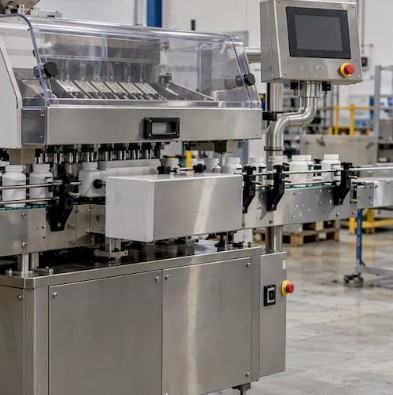
Tablet Counting Machine Cost in the UK: 2026 Price Guide

A tablet counting machine in the UK typically costs between £4,000 and £60,000 before VAT. Where you land depends on how many tablets a minute you need to count, how accurate the count must be, how much of the line around the counter you want automated, and what support comes with it. The purchase price is only part of the picture. Training, spares, changeover time and the cost of a wrong count over a year often matter more than a few thousand pounds on the quote.
This guide is for operations and procurement managers in pharmaceutical, nutraceutical, cosmetics and food businesses who are budgeting for a counter. It shows what each price band buys, what pushes a quote up, and how to compare machines on cost per correctly filled bottle rather than on the headline figure. If you want to check a specific machine against your product, our tablet counting machines are built and customised for the product and container you run.
TL;DR
- Budget £4,000 to £60,000 for a tablet counting machine in the UK, excluding VAT. Small semi-automatic units sit at the bottom, fully integrated automatic lines at the top.
- Speed, the number of channels, vision inspection, dust control and integration with filling, capping and labelling are what move the price.
- Accuracy depends on the machine and on your product: coating, shape, dust and chipped tablets all affect the count.
- Add VAT at 20%, installation, operator training, spares and a service plan to the machine price to get the real cost of ownership.
- Ask for a quote built around your tablet, bottle and output target, not a catalogue price.
Table of Contents
- What a tablet counting machine costs in the UK
- What drives the price of a tablet counter
- Beyond the purchase price: the cost of owning a counter
- How accurate is a tablet counting machine?
- Worked example: pricing a nutraceutical line
- How to get a quote that means something
- Pharmaceutical, nutraceutical, cosmetics and food: what changes
- Our perspective on tablet counter cost
- Talk to us about your counter
- FAQ
- Sources
What a tablet counting machine costs in the UK
The range we work to for the UK market is £4,000 to £60,000. It is wide because the term covers very different equipment. Three broad bands help with budgeting.
| Band | Typical use | What you are usually buying |
|---|---|---|
| £4,000 to £12,000 | Start-ups, small nutraceutical brands, short runs | Compact semi-automatic counter, operator loads and removes bottles |
| £12,000 to £35,000 | Growing producers, contract packers | Automatic counter with a bottle feed, higher speed, easier changeover |
| £35,000 to £60,000 | High-volume pharmaceutical and nutraceutical lines | Multi-channel automatic counter, inspection options, integration with the rest of the line |
These bands are a planning guide, not a price list. Two machines at the same price can behave very differently on a sticky soft gel or a fragile coated tablet, which is why a quote should start with your product.
The prices above are before VAT. The standard rate of VAT in the UK is 20% on most goods, so a £30,000 machine is £36,000 on the invoice. VAT-registered businesses normally reclaim it, but it matters for cash flow on the day you pay.

What drives the price of a tablet counter
Speed and number of channels
Output is the biggest single driver. A counter that fills a few bottles a minute needs fewer counting channels and a simpler feed than one that must keep pace with a filling line. More channels mean more sensors, a larger hopper and tighter engineering, and the price rises accordingly. Buy for the output you need in the next three to five years, not the output you have today: replacing a counter that has been outgrown costs more than specifying the right one first time.
Product range
Hard tablets, coated tablets, capsules and soft gels all behave differently. Round white tablets are the easy case. Oblong capsules, shiny soft gels and small or irregular tablets need a different feed and counting set-up. If you run several products on one machine, the price reflects the range of change parts and settings it must handle. Tell the supplier every product you expect to run, including ones you plan to launch.
Automatic or semi-automatic operation
A semi-automatic counter needs an operator to place and remove each bottle. An automatic machine takes bottles in, counts, fills and releases them. The automatic version costs more but removes labour from every cycle, so it usually repays itself on any run that is more than occasional.
Vision inspection
Camera systems add to the price and to the quality of the output. One industry report describes camera vision that can inspect tablet and capsule colour, shape and size, detect defects and product mixing, and analyse products every 50 ms. For pharmaceutical work, where a wrong or damaged tablet in a bottle is a serious problem, this is often worth the budget. For a food supplement with lower inspection needs, a standard sensor-based count may be enough.
Dust control and hygiene
Tablets shed powder. Dust extraction, easy-clean contact parts and stainless steel construction add cost, but they cut cleaning time between batches and protect the sensors that do the counting. If you change product often, cleaning time is a direct cost, so it belongs in the comparison.
Integration with the line
A counter on its own is cheaper than a counter that feeds a capper, an induction sealer and a labeller in sequence. Integration needs conveyors, accumulation or rotary tables and controls that talk to each other. It is the biggest reason a project quote ends up above the machine price. Our range covers the surrounding equipment too: capping machinery, induction cap sealing, labelling machines and accumulation and rotary tables, so the counter can be specified as part of one line.
Customisation
A machine adapted to your bottle sizes, tablet types and layout costs more than a standard unit, but it avoids the cost of working around a machine that nearly fits. Customisation is how we build machines at KBW, so the quote reflects your operation and not a generic specification.
Beyond the purchase price: the cost of owning a counter
A quote that looks cheaper can cost more over five years. Build the comparison on these items.
- Installation and commissioning. Someone has to place the machine, connect it and prove it runs your product at the speed promised.
- Operator training. A well-trained operator keeps the count accurate and reduces stoppages. Installation and training is part of what we provide.
- Change parts. If you run several bottle sizes or tablet shapes, each may need its own parts. Price them at the quote stage.
- Spares and wear items. Ask which parts wear, how quickly, and what they cost.
- Service and maintenance. A service plan spreads cost and reduces unplanned downtime. We offer ongoing support and maintenance for the machines we supply.
- Downtime. A line that stops for a day costs more than most service contracts.
- Validation time. In pharmaceutical settings, documenting that the machine does what it should takes staff time.
A simple way to compare two quotes is to add the five-year costs of items 1 to 6 to the purchase price, then divide by the number of bottles you expect to fill. That gives a cost per bottle which is far more useful than the sticker price.
How accurate is a tablet counting machine?
A properly specified counter is far more consistent than manual counting, and accuracy is the main reason most buyers move to a machine at all. The practical question is what keeps the count correct in your plant, because accuracy is not a fixed number printed on the brochure. It comes from the machine and the product together.
Counting method. Most counters pass tablets through channels where a sensor detects each one as it falls. The sensors need a clear, regular flow. If tablets arrive bunched together, two can pass as one. A good feed design spaces them out, and slowing the speed slightly can improve the result on awkward products. How a tablet counting machine works explains the sequence from hopper to bottle.
Product condition. Chipped tablets, broken capsules and powder create false counts. A tablet that has split in half may be counted as two. Dust can dirty a sensor over time. Keeping the product in good condition before it reaches the counter helps as much as the machine does.
Product shape and coating. Tablets that are very small, very flat or sticky are harder to separate. Soft gels can cling to one another. Tell your supplier exactly what you run so the feed and sensors are set up for it.
Cleaning and calibration. Sensors that are dirty or out of adjustment drift. A routine of cleaning between batches and checking the counter against a known quantity keeps the figure steady.
Inspection. Where a bottle must contain only the right product, camera inspection adds a second check beyond the count, looking at colour, shape and size as described above.
Check weights. Many plants weigh a sample of filled bottles as an independent check on the count. It is a cheap routine that catches drift early.
When you compare machines, ask each supplier the same question: what count accuracy does the machine achieve on my tablet, at my speed? The answer for your product is the one that matters, and it should be agreed before you buy.

Worked example: pricing a nutraceutical line
Take a UK nutraceutical firm filling 60-count bottles of a coated tablet, aiming for about 20 bottles a minute on a single shift, with plans to add a second product next year.
A semi-automatic unit at the lower end of the range would cost least but would tie an operator to every bottle and could not reach that output. An automatic counter in the middle of the range, with a bottle feed and change parts for the second product, fits the target. The firm then adds the cost of connecting it to a capper and a labeller, plus installation, training and a service plan.
The machine might be £25,000, but with a capper and induction sealer, installation and a service plan the project could be well above that. On a cost per bottle basis, however, the automatic line wins at this output because it removes labour and rework. The point of the example is the method: build the whole-line number, then divide.
How to get a quote that means something
You will get a more accurate price, faster, if you send the supplier the following:
- The product: tablet, capsule or soft gel, with size, shape and coating, and a sample if possible.
- Containers: bottle or jar type, neck size and fill counts.
- Target output per minute and shifts per day.
- Other products you plan to run.
- The rest of the line: what comes before and after the counter.
- Your quality requirements, including any inspection or documentation needs.
- Floor space and power available.
With that, we can recommend between models such as the AC500 pill counter and the AC2000 automatic tablet counter, or configure something to your requirements. If you are choosing for the first time, our guide to choosing the most suitable tablet counting machine goes through the decision in more detail. Smaller operations can also look at packaging machines for small businesses.
Pharmaceutical, nutraceutical, cosmetics and food: what changes
The price bands apply across sectors, but the weight of each cost differs.
Pharmaceutical. Accuracy, documentation and cleanability dominate. Inspection options and validation support justify a higher budget. See our pharmaceutical packaging machines.
Nutraceutical. Product variety is the main factor: capsules, soft gels and tablets, often on one line. Changeover speed and the range of change parts matter most.
Cosmetics. Counting is less common but applies to items such as supplement-style beauty tablets and capsules. Integration with filling and labelling usually drives the budget.
Food and beverage. Supplements, confectionery tablets and similar products are counted at high speed. Output and ease of cleaning usually decide the specification.
Our perspective on tablet counter cost
We have installed over 1,650 machines worldwide in more than two decades, and the conversation about cost nearly always starts in the wrong place. Buyers ask for the price of a counter. The better question is what each correctly filled bottle will cost over the life of the machine.
That is why we build around your product. A counter tailored to your tablet, your bottle and your output target avoids the slow starts, the workarounds and the changeovers that quietly add to running cost. Training for your operators and ongoing maintenance for the machine are part of how we deliver that.
If you are working within a budget of £4,000 to £60,000, tell us what you run and what the line looks like. We will tell you which configuration fits, and what it would take to add capping, sealing or labelling later.
Trevor Banks
Talk to us about your counter
We design and manufacture tablet counting machines for tablets, capsules and soft gels, customised to your containers and output, with installation, training and ongoing support and maintenance. Send us your product details and target output and we will recommend a configuration and give you a quote for the whole line. Start from our tablet counting machine range or contact us through our site.

FAQ
How much does a tablet counting machine cost in the UK?
Expect to budget between £4,000 and £60,000 before VAT. Compact semi-automatic units are at the bottom of that range and integrated automatic machines with inspection are at the top. VAT is added at 20%, and installation, training and service come on top.
What makes one tablet counter more expensive than another?
Speed and number of channels, the range of products it must handle, automatic bottle handling, vision inspection, dust control and integration with capping, sealing and labelling. Customisation to your containers also affects the price.
How accurate is a tablet counting machine?
Accuracy depends on the machine and your product. Regular tablet flow, undamaged product, clean sensors and a sensible running speed all support a correct count, and camera inspection adds a further check. Agree the expected accuracy on your own tablet before you buy.
Is a cheaper semi-automatic counter enough for a small business?
For short runs and low volumes, a semi-automatic counter can suit a small business well, because the operator handles the bottles. As output grows, an automatic machine takes over that labour and lowers the cost per bottle.
Do I pay VAT on a tablet counting machine?
In the UK the standard 20% rate applies to most goods, according to GOV.UK. VAT-registered businesses can usually reclaim it, so check with your accountant how it applies to your purchase.